MARSHLAND LITE
Larger-than-life chamber tutti filmic choir with up to 13 dynamics, recorded in the same room as the Vista II series

Larger-than-life chamber tutti filmic choir with up to 13 dynamics, recorded in the same room as the Vista II series
Marshland Lite is a filmic tutti choir library with a larger-than-life sound despite its chamber size (three women and three men in octaves).
The main feature of the library is a 13-dynamic, 14-syllable patch with recorded same-note syllable repetitions, alternate repetition & release options (velocity-controlled), and a melisma control. This patch is accompanied by a wide variety of dynamic vowel sustain patches with different colors and attributes, including one of my early forays (at the time) into my “phrased sustains” approach which helps keep lyrical attack phrasing continuity for chordal playing. There are a multitude of decidedly experimental and aleatoric-esque FX patches including repeated syllables, vowels with drifting pitch, and other miscellaneous FX.
Marshland Lite was recorded in the Vista II space and blends very well with it. It could be easily titled “Vista II – Choir” but I decided to stick with the original, established name to avoid confusion.
The library primarily consists of three women and three men in octaves. However, the sound (particularly on the syllable patch) is reminiscent of a larger group but with some of the detail and articulation of a chamber size.
Syllables
This is the focus of the library, featuring 13 dynamics from extremely soft to very loud. Fourteen syllables in this patch. There’s a bias towards straight-tone (especially compared to Oceania), but it develops more vibrato with the mid to higher dynamics.
Holding down the sustain pedal while repeating notes triggers natural syllable repetitions.
There’s also a melisma control (added towards the end of the production process) that – if you’re holding down other notes like in a chord – carries over the vowel without re-triggering the beginning of the syllable (i.e. keeh-eeh-eeh).
You also can trigger alternative -s releases & repetitions via velocity (adjustable range via the GUI).
I recorded these 14 syllables in a pattern so that they work cohesively (especially with the same-note syllable repetitions). However, just like with the Oceania libraries, you can override the syllable pattern with key-switches (I consider this integral for phrase-shaping). So you can move around in the relatively large number of syllables options.
There is some movement in the sustains reminiscent of the old “active-bow” approach I started doing in the past. It’s subtle though and the large number of dynamics helps obfuscate anomalies which might be more obvious listening to a single dynamic layer alone.
The vowel attacks of these were variations on early “phrased sustain” ideas I was trying on choir, so they have some spirit to them as well, even though it’s a gentle sound.
The downside is that this patch is very intensive resource-wise. Personally I don’t find myself needing to run all the mics and you can also adjust pre-load. That said, I also made a patch with cut-down dynamics for less powerful machines.
Phrased Sustains
A collection of vowel sustains (ah, eeh, eh, mm, oh, and ooh) utilizing an early take on the “phrased sustain” approach. The attacks sound somewhat like they’re coming from another pitch which helps keep the phrasing more natural. Up to 11 dynamics.
Traditional Sustains
Vowel sustains (ah, eeh, eh, mm, oh, and ooh) with some variations (different levels of vibrato). Most of these are eight dynamics.
Tonal Repetition Sustains
Loose, unmeasured repeating of syllables (chi, lah, loh, soh, tee, teh) with four dynamics. These are experimental FX patches.
Noise Sustains
These are tonal but I had them do some more unusual sounds (zz, grr). Up to 8 dynamics.
Ghostly Sustains
Multiple vowels (ah, eeh, eh, mm, oh, ooh). These waver on the pitch and respond to dynamics. Eight dynamics.
Gothic Sustains
Over-the-top, caricaturesque vibrato vowel patch (ah). Five dynamics.
FX
Misc / Bonus
Various solo soprano and bass FX, staccatos, and tonal repetition sustains – very limited.
“Lite” is in the name (essentially because of the fact that it’s a mixed 8va choir), but this choir was basically intended as a playable and natural film choir option that wasn’t dynamic-limited to just soft stuff, but can do that very effectively anyway. It works well with Vista II.
* * *
* * *
Here are a few tips for the syllables patch based on my own preferences.
How does this library fit with Vista II?
It’s recorded in the same room as Vista II with the same general mic setup and positioning. It could essentially be considered “Vista II – Choir.” A colleague actually suggested I call it that, but at that point I had already been calling it Marshland Lite for quite some time so I stuck with that.
Why the “Lite” in the name?
I originally started it as a proof-of-concept project. I wanted to do a filmic, more neutral (rather straight tone) choir that was different than the Oceania libraries. I decided to do it as an 8va library (men and women in octaves), with the idea that if it was well-received I would consider a larger, dedicated choir with separate women and men sections, etc. Will that happen? I don’t know. Perhaps it will if Marshland Lite does very well. I’m certainly interested in doing more choral sampling and I learned a lot doing this library.
How does this library fit with the Oceania libraries.
The Oceania libraries were also recorded in this same room. So Marshland Lite, Vista II, and the Oceania libraries were all recorded in the same space.
Marshland Lite should blend particularly well with Oceania III.
The pattern was recored in the following order:
Here are some aspects of the library that might affect your purchasing decision. Putting together this list is always very subjective when I’m in the final stages of production, and just because something appears here doesn’t mean it isn’t an “issue” in other PS libraries where I didn’t mention it. Here are a few things, in no particular order.
System Performance: General
This is the elephant in the room with Marshland Lite. Primarily the main Tutti Syllables patch.
This particular patch is especially heavy because of the number of dynamic layers and elements in the patch (14 syllables, sus reps with -s and without, releases with -s and without, etc). Another aspect is that I did pitch-shifting externally for the most part, so that I could do formant-follow (critical for choir, in my opinion). So the zone count is pushing Kontakt’s limits. It’s the nature of the beast with this patch.
In terms of numbers, if I open the main ML – Tutti – Syllables patch and play a single note with all mic positions on, there are 104 voices playing, which changes to 52 voices after a couple seconds. If I just have the decca mic loaded, it is 26 voices which changes to 13 voices after a couple seconds.
A couple general suggestions:
There is a “lighter on CPU” alternative patch for the syllables that has five dynamics. It’s not as good, in my opinion, because of the more limited dynamics. But multiple testers were fine with it.
System Performance: Kontakt 6
In beta testing, I noticed an issue that appears to be specific to Kontakt 6. Exporting from DAW with all mics loaded bugs out the sound. Some devs may feel that this would be a reason to release for Kontakt 7, but I use v6 primarily so I still wanted to release for v6. I don’t see a “fix” in sight for this in particular, considering the patch is pushing Kontakt’s zone limit and thus inherently resource-heavy.
Noise Floor
The level of noise in this library may be more noticeable at lower dynamics than what some people prefer. The AM (ambient) mics are noisier than the other mic positions. Just keep them lower.
The library (especially the main syllables patch) gets extremely soft, so that is very much worth keeping in mind as well as it will obviously sound noisier at those super low dynamics.
The soloists have a fairly evident noise floor too.
Extended Register
The range is artificially stretched at the top and bottom of the keyboard for those who want some register extension without needing to go into the wrench settings of the instruments. But because it is artificial, it can sound slightly unusual in isolation. However, it’s available for those who want it.
Mic Consistency
On the close mic, the stereo image can shift a little bit across the range. Each dynamic of the main 13-dynamic syllables patch had its own recording session, so there’s some natural variation from 13 different session in the close mic.
Performance-Related / Misc
Soloists – I consider this bonus material, it is very limited (no dyn) and meant more for FX/experimental work. Whatever expectations you have for these patches, lower them.
Tonal Rep Sus – some of these have very loose attacks and performances, particularly the bonus patches.
Some noise and artifacts from the sampling approach are present in the attacks, particularly on the syllable patches (it was an early take on “phrased sustains”) and the phrased sustain patches. There is also some pre-note ambience, but it’s not that audible in context. As an alternative for the phrased sustain patches, you can use the traditional sustain patches.
The syllables patch pre-roll is 180 ms and not adjustable.
* * *
* * *
I’ve written some guides below for taking advantage of the loyalty pricing. The process is not complicated, but there are some important intricacies so please read carefully.
$199 – Special Loyalty Intro Pricing for owners of Pacific – Ensemble Strings, Pacific – Brass, Pacific – Percussion, Pacific – Solo Strings, Pacific – Woodwinds, Vista II – Small String Ensembles Lite, Vista II – Solo Cello Legato, and any other Vista II module released during this product’s intro period.
Search through your emails for your applicable loyalty code. This is the code you received as part of your product fulfillment emails when you purchased any of the above products – it’s not a code that was sent out when Marshland Lite was released. The email subject should look something like this:
Your loyalty code for [product]
Grab the code at the bottom of that email. It should look something like (not this specifically — this is just an example):
VIISSEL3KL108D5
During checkout you will come to this page.
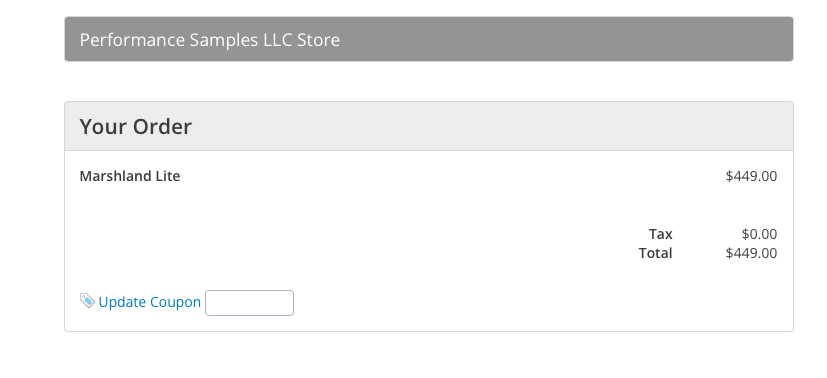
Take the code from your email and paste it into the box on the lower-left. Then suffix your specific code with this exact phrase:
-ML
So the entire code should look something like this (for example):
VIISSEL3KL108D5-ML
It won’t work without the hyphen. Now hit “Update Coupon.” It should update the price:
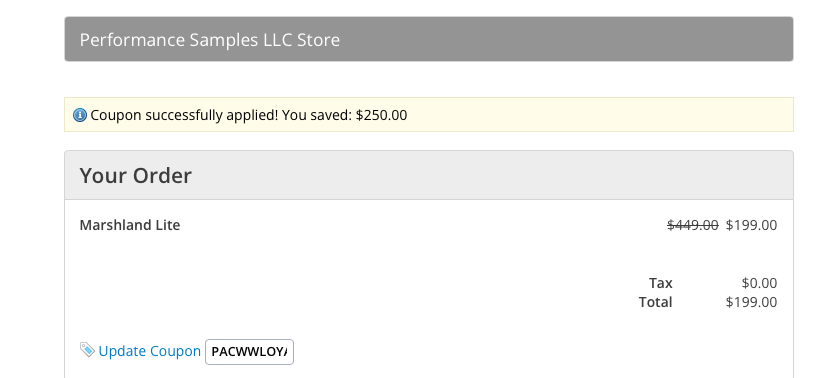
$349 – Normal Loyalty Intro Pricing for owners of Oceania I/II, Vista (original), Caspian, or any paid Con Moto modules.
During checkout you will come to this page.
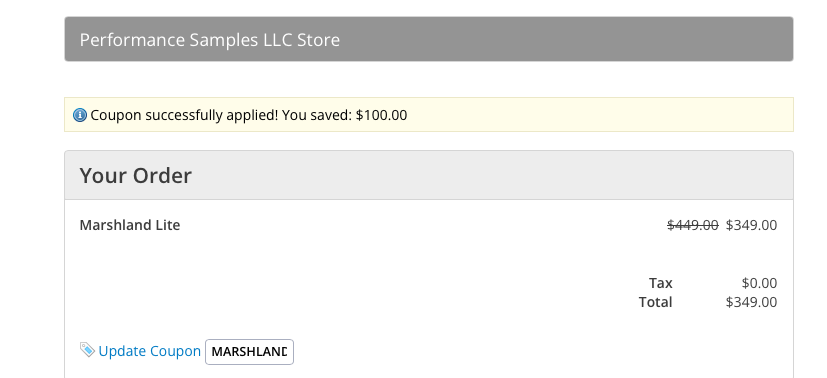
Paste this code into the box on the lower-left:
MARSHLANDLITELOYALTYINTRO
Hit “Update Coupon.” It should update the price.
Qualification for loyalty pricing subject to verification by Performance Samples LLC, in each instance.
There are two different intro loyalty pricing schemes, depending on whether you own certain other PS products. Please see the Loyalty tab for more info & instructions. The intro price period will last through October 29th, 2026.
$199 – Special Loyalty Intro Pricing for owners of Pacific – Ensemble Strings, Pacific – Brass, Pacific – Percussion, Pacific – Solo Strings, Pacific – Woodwinds, Vista II – Small String Ensembles Lite, Vista II – Solo Cello Legato, and any other Vista II module released during this product’s intro period
$349 – Normal Loyalty Intro Pricing for owners of Oceania I/II, Vista (original), Caspian, or any paid Con Moto modules
$449 – Regular Intro Pricing for those who don’t fall into the loyalty categories
$599 – Full Price once intro period ends