VISTA II – SMALL STRING ENSEMBLES LITE
Small string ensembles recorded together in one room with new performance sampling techniques

Small string ensembles recorded together in one room with new performance sampling techniques
Vista II – Small String Ensembles Lite is the second module from Vista II, featuring two small tutti string ensembles playing a variety of articulations uniquely edited from performances recorded with an unusually large amount of dynamic range.
I am working on an update for this release that includes a lot of new content as well as exploring some fixes with the v1.0 release. Please click the tab here to see more information and to listen to some work-in-progress examples.
The library consists of additional recordings originally intended for the forthcoming Vista II – Chamber Strings module. The recordings in this library are not a “cut-down” version from another, bigger upcoming Vista II module – this is a standalone library. The idea behind these additional recordings was to record a small ensemble playing together at the same time (the solo bass was recorded separately from the other musicians so they didn’t have to wait around).
I experimented with some of the new performance-sourced approaches I have been refining as I’ve been recording Vista II, namely, sympathetic resonance short-note sampling. This resulted in more spirited shorts than the standard (for PS) repetition-based sampling, with a bit more between-pitch continuity (not just continuity when repeating the same note) and generally less overt pre-note ambience (decay from the previous note). In other words, the shorts are similar in tonal characteristics to Fluid Shorts III soloists but are (arguably) a little more vibey.
The library also includes both “normal” and whisper sustains (in the style of Pacific – Ensemble Strings), featuring a moderate vibrato (not over-the-top, except perhaps at very high dynamics). These sustains have been recorded in a non-standard way but they don’t have quite as much extra movement as usual. There are also (looped) marcatos with shorter releases, reminiscent of Pacific – Ensemble Strings.
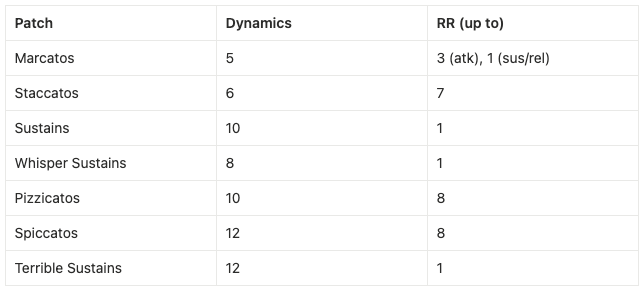
In keeping with the broader Vista II recordings (most of which are unreleased at the time of this library’s release), this library does not emphasize any specific dynamic range (aside from whisper sustains, one could argue). The performances were generally captured across the full spectrum – up to 12 dynamics – from very soft to very loud. The FFF layers, in particular, are rather intense and deliberately chaotic and noisy (for the shorts primarily).
The use case for this module is a small tutti string ensemble sound that functions on its own, for sketching, or for doubling other sections (like the other modules in Vista II). It also provides a sense of the Vista II sound and what you may expect in terms of stage and response to reverb processing.
For the sake of being abundantly clear, these are not individual sections — it’s two separate tutti ensembles.
* * *
* * *
VII – SSEL – Ens A – Marcatos.nki
VII – SSEL – Ens A – Staccatos.nki
VII – SSEL – Ens A – Sustains.nki
VII – SSEL – Ens A – Whisper Sustains.nki
VII – SSEL – Ens B – Pizzicatos.nki
VII – SSEL – Ens B – Spiccatos.nki
VII – SSEL – Ens B – Terrible Sustains (bonus).nki
* * *
* * *
Is it a cut-down version of an upcoming Vista II module?
No, the content here is not a cut-down version of another module, nor do I have any plans to re-release this content in another Vista II module. These recordings were created as additional material for Vista II – Chamber Strings. Although they were initially intended as bonus content for that library, I ultimately decided they would serve better as a separate module. To clarify, this material is not included in Vista II – Chamber Strings, which features legato, a wide range of articulations, and – most importantly – a section-based approach (rather than being recorded in tutti). This is just a smaller, supplementary module.
Why is it called “lite?”
The “lite” primarily refers to the fact that it’s a lightweight patch list and kind of “bonus” material, arguably.
Are these separately recorded sections that you baked together like the lite patches in Pacific – Ensemble Strings?
No – these are two small ensembles recorded at the same time, in “tutti.” Meaning that there were actually – take Ens. A for example – two violins, two violas, and two cellos playing in unison at the same time on the same session. I recorded the bass/basses on a separate section since their register doesn’t interfere with the cellos (for v1.0 of the library, anyway).
Why do you have two different ensemble sizes?
I recorded the 3-3-3-2 ensemble first, thinking I would keep things simple and get arco shorts, pizzicatos, and sustains. I completely missed the mark with the sustains on those particular records (which are still included as a bonus), and decided to do “everything” again but with a smaller group (which I didn’t get around grabbing pizzicatos on, but I did have time to grab marcatos).
This sounds bigger than the section sizes listed / bigger than a chamber section.
That may be true. There is something compelling to me in small ensembles that have a more layered approach from more dynamics (such as this library). I’m not always concerned with getting a strict chamber sound or a strict “anything” sound. If it sounds good, it is good.
How are the different instruments split up?
The first octave is covered only by the bass(es). The next octave features just the cellos, after which the violas and shortly after violins join in. As the range continues upward, the cellos eventually drop out, followed by the violas. At the very top, only the violins remain, with the highest note in the patches reaching G7 concert. Overall, the instruments stay mostly within their more comfortable ranges.
Why aren’t the mic positions at unity when opening patches?
There are temp “mixes” with the mic positions when opening the patches to an optimal setup (this is obviously subjective). These can be reset easily (command-click on the mic position volume bar).
How do these compare to Fluid Shorts I/II/III?
There are a variety of differences, but first and foremost these strings are recorded in tutti (except the bass/basses), rather than in separate sections like the Fluid Shorts series. There are also patches aside from just shorts. The sampling approach is much more evolved than the Fluid Shorts series as well. Finally, this release is a module of Vista II, so you will have some continuity with the rest of the Vista II series in that respect (mic positions, positioning, etc).
What is the highest pitch in the library?
Concert G7 (which is generally where I try to aim for violins).
Articulations
Shorts
Spiccatos: off-the-string playing with a lot of grit. My favorite patch in the library.
Staccatos: (quite) connected and on-the-string. Somewhat turbulent and loose (performance-wise), in part from the sympathetic resonance approach. Good for moderate to faster tempi, in particular. These can be used for somewhat fast measured playing too. They have a rather “classical” sound.
Pizzicatos: my first commercial foray into sympathetic resonance pizzicatos. There’s a higher level of noise floor than usual because of the musicians moving around so much on the fingerboard. Because of the sympathetic resonance approach these move between different pitches a bit more naturally.
Longs
Marcatos: in a similar style to the marcatos in Pacific – Ensemble Strings.
Sustains: “standard” sustains with some level of movement. Vibrato is very moderate (not too much).
Whisper Sustains: in the style of the ones from Pacific – Ensemble Strings. Biased towards lower dynamics.
Terrible Sustains (bonus): the sustains from the original 3-3-3-2 recordings. Quasi non-vibrato.
Dynamics / RR
Microphones
CL: close mics (the closest mics, these were setup per section and can be panned around naturally)
SC: section mics (also “close” mics, but farther away than the above – these were also setup per section)
DC: decca tree (recorded as LCR – stage mics)
OR: outrigger mics (recorded as LR on the left and right of decca out on the sides – stage mics)
AM: ambient mics (LR mics – these don’t hold up as strongly on their own because of the lack of clarity mixed with some level of artifacts from the tonal aspects being harder to identify in post-production – however they’re useful to layer in)
Here are some aspects of the library that might affect your purchasing decision. Putting together this list is always very subjective when I’m in the final stages of production, and just because something appears in library limitations here doesn’t mean it isn’t an “issue” in other PS libraries where I didn’t mention it in that library’s “limitations” area. Here are a few things, in no particular order:
DAW / Technical
Voice count can add up with this library because of the number of dynamic layers and mic positions. For instance, on the main sustains (Ens A) if you hold down a single note with all mic positions loaded, that’s 50 voices just for that one note (10 dynamics x five mic positions). I think that running this library with an SSD is very important. Another obvious solution (which I use in some cases) is not having all mic positions active at once. Or you can roll back the “Release” knob as well.
Sample offset defaults to 100 ms for shorts and 80 ms for longs. This might seem like a lot for some users but you can change it – but only for shorts. They can go anywhere between 20 and 140 ms. Feel free to adjust it to your preference.
Noise
The level of noise in this library may be more noticeable than what some people prefer. Please listen carefully to the examples before purchasing.
The most apparent case is in the pizzicatos, where the noise floor is higher due to the natural sounds of players shifting on the fingerboard. In my experience, reducing noise floor can easily strip the life from recordings, especially with something as delicate as pizzicatos. Chasing down this type of noise is not a priority nor a direction I’m interested in pursuing. I mention this up front so you can decide if this library is the right fit for you.
Mechanical/bow clicks in the performance have also been retained esp. for higher dynamics (for instance, in the low strings registers).
In general, the noise reduction is rather light and is more focused on incidental noise (like chair scrapes or various anomalies during the sample decays/tails) rather than noise floor reduction — and even then, it’s lightly applied.
Some noise/artifacts (from the sampling approach and process) are in the attacks for the sustain patches. If you want to tame these a bit (at the risk of a bit less “connectivity/glue” in the attacks) you can do the following. Open the patch(es), then go under the hood by hitting the wrench, then select and “edit all groups” for all of the sustain groups (you can search for “sus” in the Expert panel), then set the attack curve to linear or default (which is a bit concave). By the way, you can Command-click the curve (on Mac) to reset it to default. You can also extend the attack amount to beyond 80 ms… try 140 ms, etc. It will fade-in the attack more.
Harmonics / Ghost Notes
This could be included in the above section, but I thought it needs its own section. You’ll sometimes hear slight “ghosts” of other pitches when playing a given pitch. This generally happens in the beginning/attack of the note, and is a result of the particular sympathetic resonance sampling approach I use. For better or worse, this (arguably subtle) effect is par for the course and generally not something I see as an issue that needs surgical spot fixes in my post-pro. Check out the solo cello in the Fluid Shorts III demo freebie and it may give you a better idea of this. I don’t think its a hugely troublesome in this particular library, but it was still something I wanted to mention.
Pre-Note Ambience
I don’t believe this to be a huge issue for this particular library, but it is still worth mentioning in my opinion. A background on what I’m referring to: when note attacks are recorded in some sort of repetition, like for the shorts in this library, there can be some level of hearing the “ghost” of the previous note during the attack (when you play a note), even if the volume envelope curve is linear or concave. Of course, having a concave linear curve has downsides, especially on shorts patches where you can lose cohesion in a sequence. There are some controls and functionality to adjust it to your preference, like the sample offset and the controls on the “A” page. Just keep in mind that there is a trade-off. If you want really clean attacks you may end up with a disconnected, less cohesive sound. The defaults in the patches are generally what I thought sounded pretty good (striking a balance, if you will), and you can adjust it from there. On the “A” page you can adjust the “Slope Min” and decrease the values for each mic position which will make them more concave (and less cohesive). You may find that you want different settings depending on the piece of music or section you are writing.
The AM (ambient) mics are less usable than the rest of the mics because of the distance causing issues with the performance and rep sampling. It’s the nature of the beast with this sampling approach. Don’t expect nearly the same response from them as you get from the decca, for instance. They generally will need to be layered down – and they can work for that – but not so much exposed.
Misc
Marcatos have somewhat shorter loops and are rather limited with RRs (up to three on the attacks and just one for the releases).
In terms of performance, there is some rather fervent bow-changing on some of the sustains.
Some releases are slightly truncated before they decay entirely because of the pace of the recording sessions moving on to the next pitch.
Some inconsistency in section/close mics as these are tutti recordings and on different session dates.
There are some messy lower bass grafts on the short arts.
* * *
* * *
Originally written on December 25, 2025
Edited on Mar. 7, 2026
I have a v2.0 free update coming for this library. The update has previously been called v1.1/v1.5, but considering the vast scope it will be v2.0.
When is the v2.0 update being released? I have it in post-production and now that musicians are back from the holidays as we get into January, I’m getting closer to finishing sessions. I think it’s reasonable for me to aim for a release sometime in very late February 2026, but that’s not a promise as I have a TON on my plate.
What does the v2.0 update consist of? Most notably, a sizable amount of new free content. My general goal initially with this update was to record articulations for Ens. A that were only recorded for Ens. B (the larger ensemble) in the v1.0 release (spiccatos and pizzicatos – I’m not including the “terrible sustains” in this as it was just a bonus which I wasn’t happy with). I also wanted to finesse some small aspects/fixes that exist/existed in the initial v1.0 release. But it has turned into much more.
This update will be available for new purchasers as well as existing customers. Existing customers will receive a Continuata link when the v2.0 update is out.
If you want to skip some of the text below and simply see a (non-final) overview of the new content I have been (and will be) recording for this update, click here.
One issue that I have seen customers mention with the original v1.0 recordings is that the cello timbre in the higher register upsets the balance a bit, giving a more sonorous tone to the mid-higher range of the violins/violas. For these new recordings, I’ve generally leaned towards range-limiting the cellos a bit, as well as having the two cellos dropping to just one by around G3 concert and then its just the first chair for a bit to “taper” the sonorous timbre out, then I have the first chair drop off. Same thing with the violas – they generally don’t go quite as high on the new recordings and also I have the 2nd chair drop off in advance of the first chair, just like the cellos.
For these new v2.0 recordings I’m separating out the bass. It’s not only in a separate patch, but the range isn’t limited to just an octave – I’m recording more of a standard register of around ~3 octaves (rather than around an octave, like on the v1.0 recordings). You will still be able to double it if you wish (making a multi, etc) with the Ens. A (2-2-2 — 2 vln / 2 vla / 2 vc) ensemble but you will have separate control now (just for these new recordings, of course – the 1.0 recordings I did are still around an octave).
My first order of business was to record the articulations that I had not recorded for the Ens. A group in the initial v1.0 release: spiccatos and pizzicatos. As a reminder, the Ens. A group is 2-2-2-(1) – two violins, two violas, two cellos, and one bass. Of course, for this v2.0 release, the bass will be separated out. The Ens. B group is 3-3-3-2 (three violins, three violas, three cellos, and two basses). I didn’t do any Ens. B recordings for this new v2.0 update. I am focusing on the Ens. A size.
Here is a video I uploaded comparing the new v2.0 Ens. A spiccatos and pizzicatos to the v1.0 Ens. B spiccatos and pizzicatos.
You can skip the initial talking and start at 01:06 if you want.
I’ve also recorded an articulation called “Long Staccatos.” Here’s an initial video I uploaded demonstrating them.
You can begin at 00:45 to skip the talking at the beginning.
I also uploaded an example here that shows the Long Staccatos demonstrated and two different tempi.
The new Tenutos are also shown.
I also experimented with loure sampling. I wasn’t that happy with these, but in the time since uploading the video I have figured out how to fix the attacks to be more natural. So ultimately I think it will be OK.
I have also been recording other articulations (including some staccatissimos that should be decent – but I haven’t uploaded any examples of them to YouTube yet).
Because a lot of these approaches are building off of the approaches established in previous recordings I have done for other modules of Vista II (primarily the Chamber Strings module), you can hear a rough idea of how they sound (or how they sounded when I did them on other recordings). These examples are not from the v2.0 recordings, but the v2.0 recordings will be roughly based off of the score/post-pro approaches used for the techniques demonstrated here.
I plan to have playable trills, roughly modeled off the approaches used here.
Start the following video at 00:29 to hear the playable trills. These aren’t sustaining trills – they’re “normal” fast trills but you play them in versus holding down a key(s). They don’t really sound “good” under a certain speed. These recordings are from the forthcoming Chamber Strings module, but the general idea is still there.
Here’s another example. Again – from the Chamber Strings module.
I also plan to have some slower playable “trills” which are more like ostinato-type playing. I’m using this approach as a reference. Again, both these recordings are from the Chamber Strings module.
Here’s an overview of what I have recorded so far and what I still need to record. Around this time of the year the musicians are on holiday, so while I did squeeze in some sessions recently, I still have more sessions to do in January (hopefully they can all be wrapped up in January).
The “legato attack” functionality I mention is probably best described as patches where the note have a certain level of movement/waver in the attacks that makes them sound “phrased” or like they came from a different pitch.
It’s redundant to mention it here, but when I say speculative below it means it’s not fully confirmed yet (in terms of the not-yet-recorded content). So the articulation list and specifications truly won’t be finalized until release – it’s just the way development goes (there are sometimes surprises, etc and certain ideas don’t work out very well for a variety of reasons).
Naming and final patches still in-flux, but all recordings are done.
* * *
* * *
This is a small set of patches from Vista II – Small String Ensembles Lite. This is not the upcoming v2.0 free content update. That’s a huge content update that will be free for existing owners and of course new purchasers of the library will get it as well. For more info on the v2.0 free content update, please see the tab on this product page.
Anyway, this is just a tech demo freebie to give you an idea of what you can expect from the full library in terms of the timbre of a small tutti string section, dynamics, room, depth/imaging, and so on. I did not include any patches from the v1.0 release. The patches in this release are from the v2.0 update.
I didn’t want to have any intentional register or dynamic limitations (the proof of concept patches were just tests though and are limited). These patches may undergo naming and other finalization/changes before the v2.0 official release, including naming changes, GUI changes, script fixes, patch adjustments, noise removal, etc.
Molto Espressivo Phrased Sustains
Listen here.
Ensemble A (2 violins, 2 violas, 2 cellos). Eight dynamics. These are sustains recorded and post-produced in a specific way to sound like they’re coming from another note, or emotionally “phrasing.” Yes, the vibrato is pretty over-the-top and there’s also a lot of obfuscated bow movement within the ensemble which can sound a bit wobbly and quasi artifact-y. Don’t worry, there are natural espressivo phrased sustains in the coming v2.0 free content update recordings. They’re not as over-the-top. This patch has same-note reps. Hit the sustain pedal while you repeat notes. Also move the pitch-bend wheel up to the top to lengthen releases (portato-esque) for certain phrasing.
Brushed Spiccatos
Listen here (comparison with v1.0 spiccatos).
Ensemble A (2 violins, 2 violas, 2 cellos). Nine dynamics. These are played controlled and the bow is closer to the string. As opposed to the more bounced or dropped spiccato that has been more prevalent in past PS spiccatos.
Classical Marcatos Short
Listen here.
Two Violins. Nine dynamics. I’ve been doing a set of classical marcatos like this. The two violins stuff is kind of bonus, but can be overlayed with larger ensembles or the tutti ensemble, etc.
Proof of Concept Patches
Bonus stuff. I’ve included a couple proof of concept patches for two violins: ricochet arps and bowed ostinatos. These were initial test (R&D) patches and I didn’t record a full register or dynamic range (there are only a few dynamics). There are full register/dynamic re-records for these (for two violins) in the v2.0 free content update. The ricochet arps aren’t technically ricochet but it sounds like it. I’m playing with true ricochet additional versions for the full patches. The bowed ostinato is like a a medium-tempo playable measured trill which bow-changes every note. With the ricochet arps try going to the “A” page and bringing down the slope min on a per-mic basis (solo the mics during) until it cuts out the pre-transient noise. Less favorable for its context with fast ricochet-esque playing now, but you can have a looser short this way for repeated playing etc.
Q: Why do the patches load with non-unity mic levels?
A: Patches have different mic settings as default (just certain settings I thought would demonstrate them best initially) but you can change to taste from there.
Q: Why do tails cut-off a bit before the instruments have fully decayed?
A: Some sessions I’ve had them move to the next pitch without as many bars in between to keep them in the groove and save time. Just add verb.
Q: How close are these patches to complete? How representative of the final versions are these patches?
A: It depends. As mentioned there may be changes before release in the v2.0. I’d say these patches are around 80-95% of where they will be ultimately. The proof of concepts were just tests and are re-recorded for the actual release. I will be doing some more noise work, but to what degree is TBD.
Q: I’m hearing subtle “ghost notes” from other pitches and instrument resonance on the attacks sometimes.
A: Yes, this can come up sometimes in surgical listening and it is something that generally comes with the territory for some of my sampling approaches because of how they’re performing. It’s something that I sometimes make steps to remove in egregious cases, but the degree to which is subjective and it is also patch and context-dependent.
I plan to leave these patches up for a while but may remove them down the line if the bandwidth use gets unwieldy.
– JB
Please note that, like all other PS products, you can generate manual links (direct HTTP links) by inserting the download code you receive on the Continuata Manual Links Generation webpage.
Performance Samples freebies can be used for commercial musical work — there are zero limitations in this regard — the freebies adhere to the same EULA that the paid products do.
* * *
* * *